
A pick a date calendar fundraiser is the simplest ask in school fundraising: every day of the month has a price, a supporter picks a day, gives that much, and writes their name on it. Grandparents understand it in one sentence. Students can explain it in a text. It has raised money for bands, choirs and cheer squads on paper for decades.
This guide covers how it works, the math that caps it, a free printable sheet you can hand out tomorrow, and what changes when the calendar moves online.
How a pick a date fundraiser works
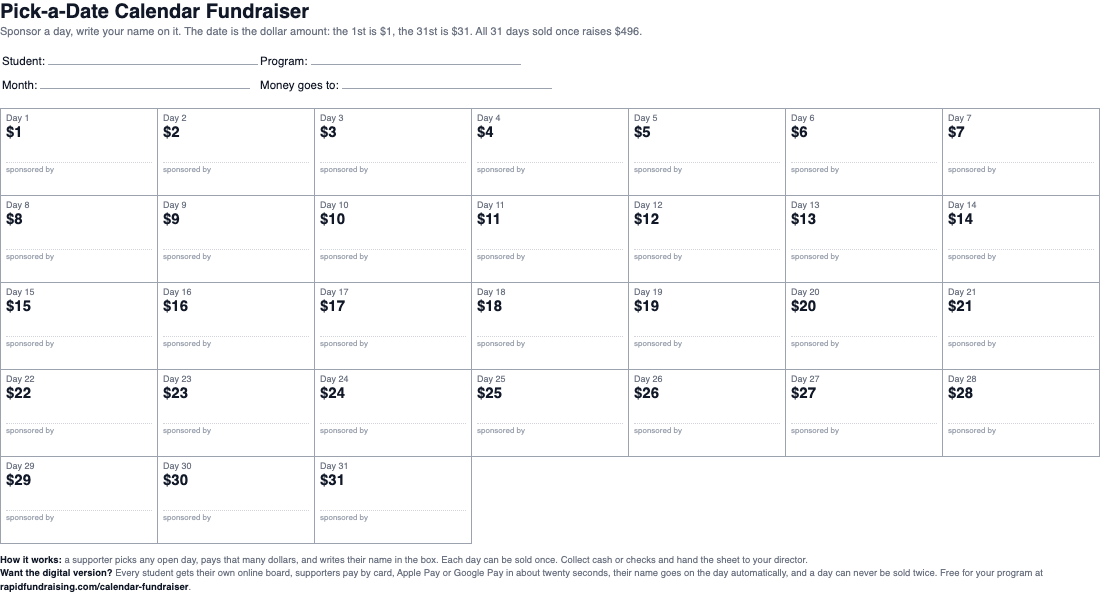
Each student gets a calendar for one month. The date is the dollar amount: the 1st costs $1, the 15th costs $15, the 31st costs $31. A supporter chooses any open day, pays that amount, and the student writes the supporter's name in the box. Once a day has a name on it, it's taken.
That's the whole mechanic. The appeal is that small gifts feel natural ("I'll take the 4th, that's four dollars"), and the name on the day gives the supporter something to see.
The $496 math
Add up 1 through 31 and you get 496. That is the most a 31-day paper calendar can raise per student, and only if every single day sells. In practice a sheet comes back with the cheap days gone and the expensive ones empty, because nobody wants to be the one who takes the 29th when the 3rd is still open. Half-full is typical.
So plan on $150 to $250 per participating student on paper, and know that the sheet, the cash and the checks all have to make it back to the director.
Free printable template
Here is a clean 31-day sheet, one page, landscape, no sign-up. Print one per student.
Running it on paper: five steps
- Pick the month. Kickoff week works best; give it two weeks, not a month, or it stalls.
- Hand out one sheet per student with the program name and where the money goes filled in.
- Have students ask in person and by text. "Will you sponsor a day on my calendar? Your name goes on it." Family first, then neighbors, then the parents' coworkers.
- Collect cash and checks with the sheet. The name on the day is your receipt trail, so the sheet matters as much as the money.
- Post the filled calendars. A wall of sponsored days at the concert is the thank-you.
Is it a raffle? No, and keep it that way
Pick-a-date is a donation: nothing is drawn, nothing is won, and every gift can carry a receipt. A calendar raffle, where each day of the month wins a prize, is a raffle, and many states regulate those or require a license. If you want to stay clear of that, don't attach prizes to days.
What changes when the calendar goes digital
The paper version has three problems the sheet can't fix: the ceiling, the cash, and the double-sold day. A digital Fundraising Board fixes all three.
- No ceiling. Each column carries its own price, so a Saturday can be $43 while a Sunday stays $8, and any supporter can take more than one day. Every student gets their own board, so the program's limit is the roster, not the calendar.
- No cash. Supporters pay by card, Apple Pay or Google Pay in about twenty seconds, the receipt is emailed, and the money lands in the program's own account.
- No double-sold day. The moment someone starts checking out, their day is held for five minutes. Two grandparents can't both pay for the 7th.
- Premier days. Homecoming, Region, State and the big trip sit under the board at a fixed amount, and any number of supporters can give toward them.
More than a month: what a board can be
A paper calendar is stuck with one shape: the days of one month, each priced at its date. A Fundraising Board starts there and doesn't have to stay there.
- A real month, or any number of days. Run it as October with the dates on the squares, or as a 28-day or 35-day season board labelled Day 1 to Day 35. Rouse and JagBlitz both run 28-day boards that have nothing to do with a calendar month.
- Your prices, not the date's. Price each column (the $8 to $43 pattern above), climb from day to day, or set one flat price for every square. The 31st no longer has to cost $31.
- Grow it mid-season. Selling out? Add days at the same prices without touching a day someone already sponsored. A sponsored day keeps the price it was bought at, always.
- One board per student, one board for the program. On Connect, every student's page carries their own board with their supporters' names on it, and the campaign page shows the whole program's board shaded by how many students have each day sponsored. On Express, for younger groups, the program runs one shared board with no student accounts.
- The name on the day is public. Supporters see themselves on the student's board the moment they pay, which is the reason people take a day instead of just giving.
- Premier days beside the board. Homecoming, Region, State, BOA: named, fixed-amount tiles that any number of supporters can give toward, any number of times, without using up a day.
- Everything else the campaign already does. Texted personal links, automatic reminders, leaderboards, a report of which days are open and which students are behind, and it sits alongside monthly giving and corporate sponsors on the same campaign.
The numbers are the argument. Rouse Band's 2026 board stood at $151,028 raised with 3,302 days sponsored by 1,586 supporters on September 4, 2026, with more than two weeks still to run. JagBlitz 2026 was at $74,136 and 1,560 days on the same board. Rouse has now raised nearly a million dollars over ten seasons with the platform.
You can try one yourself: the demo board runs in Stripe test mode, so you can sponsor a day with card 4242 4242 4242 4242 and nothing is charged.
Start with paper, or skip straight to the board
The printable sheet above is free and works. When you want the version without the ceiling, the Fundraising Board is free for your program too, and setup takes about five minutes.
Common questions
How much does a calendar fundraiser raise?
On paper, at most $496 per student, and most sheets come back half full. A digital board with per-column pricing and a board for every student removes that ceiling.
Does it have to be a calendar month?
On paper, yes, and a 31-day month raises the most. On the board, no: run a real month with dates on the squares, or a season board of any length labelled Day 1 onward, priced however you like.
Can a supporter take more than one day?
On paper, yes, if they pay each day's price. On the board, yes, in one checkout.
Is the printable template free?
Yes. No sign-up, no watermark. Print one per student.